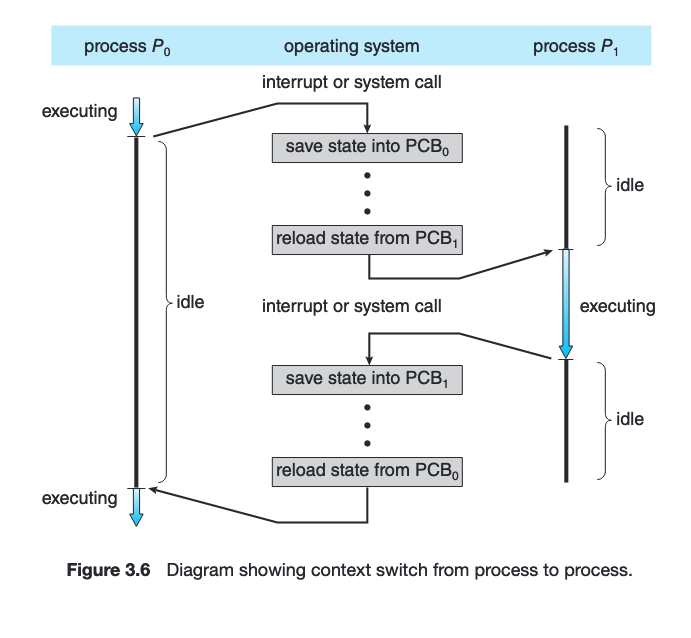
Interrupts ( todo ) makes the CPU change the current task with a kernel routine. When it happens, the context, represented in the PCB, needs to be saved so that it can restore it later. This is known as context switch.
References
- A. Silberschatz, P. B. Galvin, e G. Gagne, «Operating System Concepts».
See also
- The process scheduler chooses an available process — context switching is the mechanism the scheduler triggers when moving a process from running back to ready or waiting
- A process is represented in memory with the Process Control Block (PCB) — the PCB is exactly what gets saved and restored during a context switch: program counter, CPU registers, memory info
- In a process execution, it goes through many stages — a context switch drives the running→ready transition in the state diagram: the process doesn’t terminate, it just gets preempted
- Tail Call optimization replaces call with jmp — TCO reduces the number of stack frames that need saving during a context switch; fewer frames means cheaper context switches in recursive call chains