Model that describes communications from the physical implementation of transmitting bits across a transmission medium to the highest level representation of data of a distributed application
It is a 7-layer architecture used to define how data moves across a network.
In practice it is not implemented (TCP/IP is), but it is a standard reference.
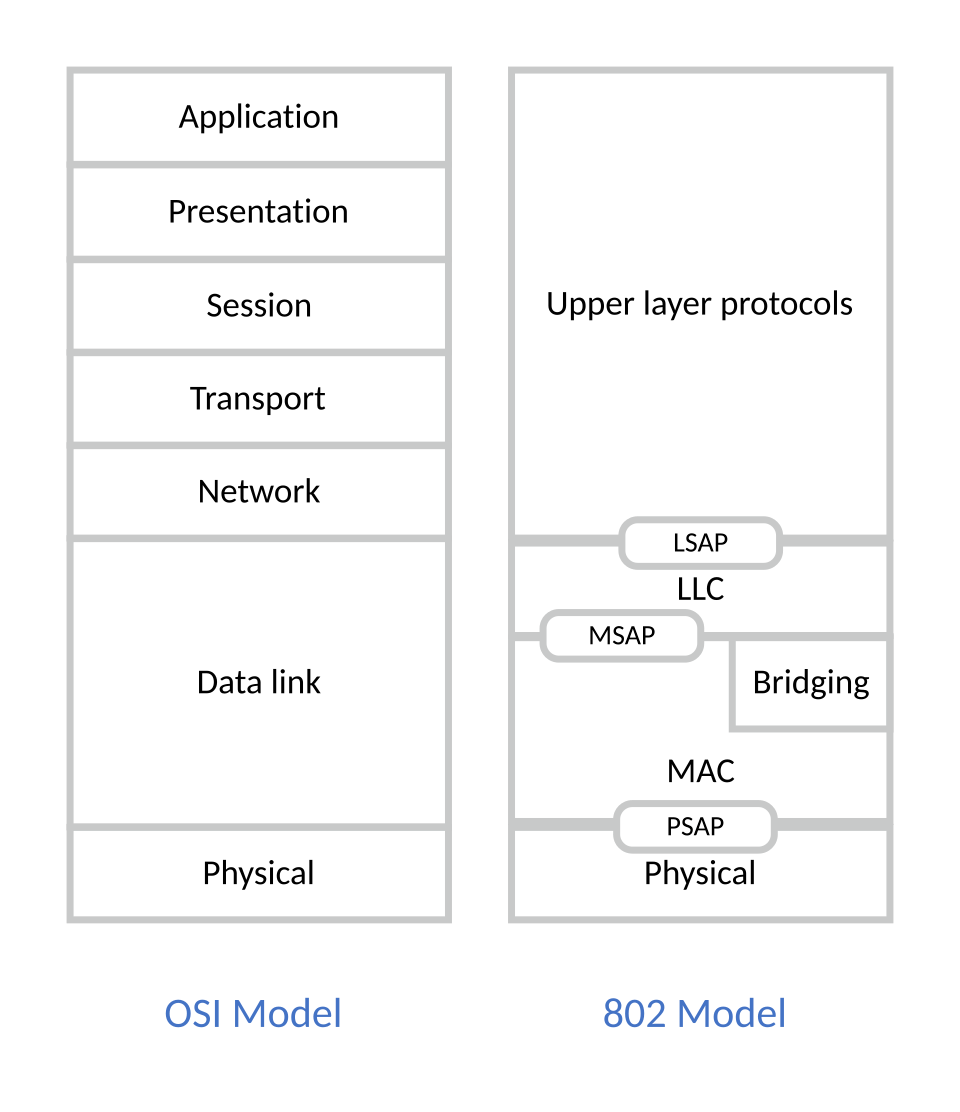
| Layer | Name | Protocol Data Unit (PDU) | Function |
|---|---|---|---|
| 7 | Application | Data | High-level protocols such as for resource sharing or remote file access, e.g. HTTP |
| 6 | Presentation | Data | Translation of data between a networking service and an application; including character encoding, data compression and encryption/decryption |
| 5 | Session | Data | Managing communication sessions, i.e., continuous exchange of information in the form of multiple back-and-forth transmissions between two nodes |
| 4 | Transport | Segment | Reliable transmission of data segments between points on a network, including segmentation, acknowledgement and multiplexing |
| 3 | Network | Packet, Datagram | Structuring and managing a multi-node network, including addressing, routing and traffic control |
| 2 | Data link | Frame | Transmission of data frames between two nodes connected by a physical layer |
| 1 | Physical | Bit, Symbol | Transmission and reception of raw bit streams over a physical medium |
See also
- An IP Address Identifies the Location of a Resource Within a Network — IP operates at Layer 3 (Network); the OSI model is the framework that gives IP addressing its place in the stack
- A process in operating systems is a program in execution — processes communicate across the network through the Application layer (7) down to the Physical layer (1); the OSI model is the bridge between OS processes and the network
- @QUICTransportProtocol — QUIC operates at Layer 4 (Transport), replacing TCP; understanding its position in the OSI stack explains what guarantees it provides
References
Questions
What is the OSI Model?::7-layer model that describes communications from the physical implementation of transmitting bits to the highest level representation of data