Select Connection: INPUT[inlineListSuggester(optionQuery(#permanent_note), optionQuery(#literature_note), optionQuery(#fleeting_note)):connections]
Technique that allows the execution of processes that are not completely in memory
- OS - Memory Management algorithms assumed that instructions must be in physical memory to be executed
- not all instructions may be needed at the same time
- virtual address space: logical view of how a process is stored in memory
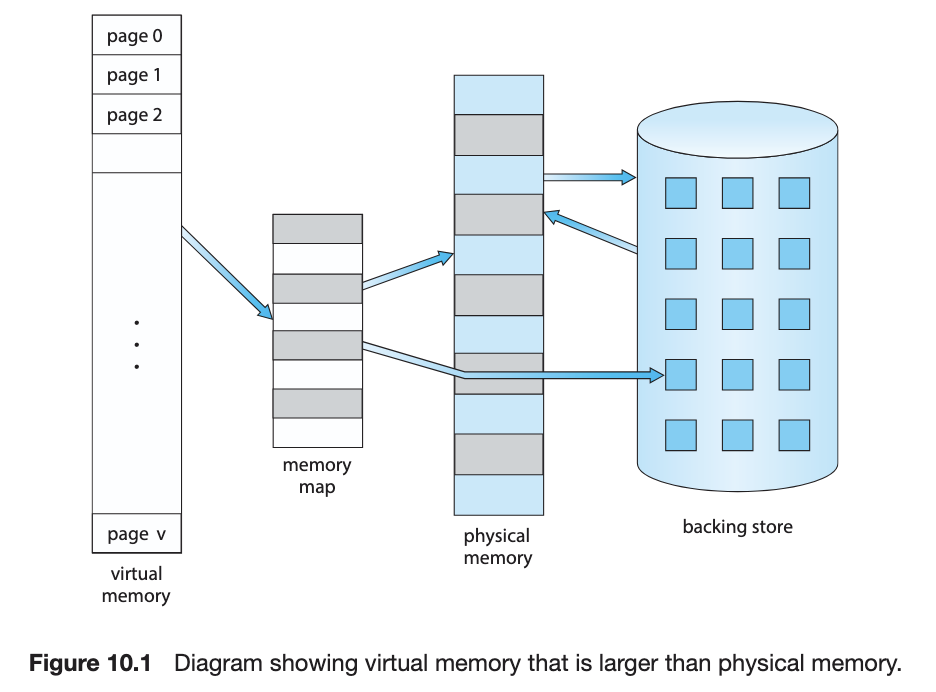
- in the virtual address space of a process in memory the stack grows downwards while the heap grows upwards
- the hole in between is part of the virtual address space but will require physical only if one of the two grows
- another benefit: files and memory can be shared by two or more processes
Demand Paging
Technique to load pages only when they are demanded
-
similar to swapping with paging but it is a reactive approach (action only when requested) compared to proactive (when RAM full, OS does swapping with paging)
-
needs hardware support to distinguish between pages in memory and pages in secondary hardware
- valid-invalid bit
- valid = page is both legal and in memory
- invalid = page is either not valid or is valid but in secondary storage
- access to pages marked invalid causes a page fault
- procedure to handle page faults:
- check an internal table to determine if the reference was valid or an invalid memory access
- if invalid, terminate the process. If valid but the page is in secondary hardware, page it in
- find a free frame
- schedule a secondary storage op to read the page into the new frame
- modify the internal table with the process and the page table to indicate that the page is now in memory
- restart the instruction interrupted by the trap
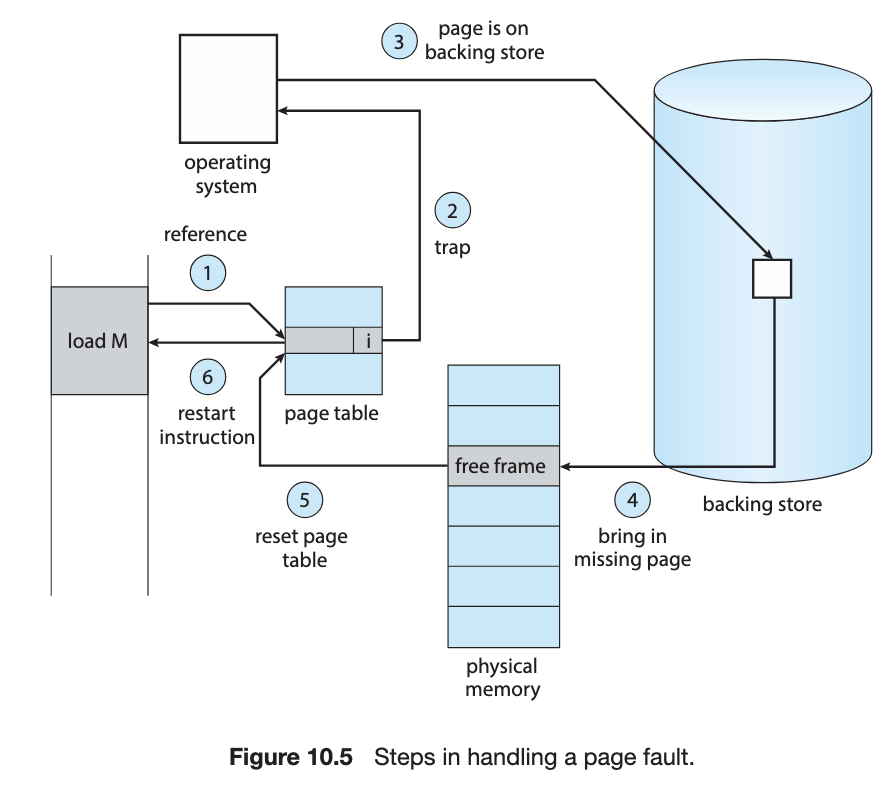
- procedure to handle page faults:
- valid-invalid bit
-
extreme case - pure demand paging: load no pages in memory at start
-
objection
- theoretically some programs could access several new pages with each instruction execution
- would impact performance
- but, in practice, programs have locality of reference
Performance Analysis
The formula is:
where is the probability of a page fault.
Assuming 8 milliseconds of paging time (with HDD) and a memory-access time of 200 nanoseconds, we get:
If 1/1000 accesses would cause a page fault, the computer would be slowed down by a factor of 40.
If we want less than 10% degradation, then:
Free-Frame list
Pool of free frames to resolve page faults
- allocated using zero-fill-on-demand
- frames are zeroed-out before being allocated (erasing previous content)
- when system starts up, all available memory is placed on the free-frame list
- when the list must be repopulated (falls to 0 or below a threshold), some strategies are used
Copy-on-Write
Instead of copying the parent’s address space,
fork()may use this technique to have parent and child processes initially to share the same pages
- pages are specifically marked
- if either process writes to a shared page, a copy of it is created
- instead of
fork()(fork with copy-on-write) there isvfork()on most UNIX (including linux and macos)- parent process is suspended
- child process uses address space of the parent
Page Replacement
-
over-allocation may happen
- while a process is executing, a page fault occurs. The OS finds that there are no free frames on the free-frame list.
- how to solve? Page replacement
-
approach
- if no free frame, find one that is not currently used and free it
- writing its content to swap space
- change the page table to indicate that the page is no longer in memory
- two page transfers are required (one for page-out, one for page-in)
- reduce the overhead by using a dirty bit
- set when any byte in the page is written into
- when select a page for replacement, examine the bit
- if bit is set, we must write the page to storage
- if not, we need not write the memory page into storage
- reduce the overhead by using a dirty bit
- if no free frame, find one that is not currently used and free it
-
frame-allocation algorithm
-
page-replacement algorithm
- how to select them? low page fault on a reference string (string of memory references)
FIFO Page replacement
-
associate with each page the time when it was brought into memory
-
when a page must be replaced, the oldest is chosen
-
causes Belday’s anomaly
- page-fault increses as the number of allocated frames increses
Optimal Page replacement
-
replace the page that will not be used for the longest period of time
-
lowest possible page-fault rate
-
requires future knowledge of the reference string
- just used for comparison
LRU Page Replacement
-
replace the page that has not been used for the longest period of time
-
implementation requires some hardware to determine the order for the frames defined by the time of last use
- two approaches
- counters:
- each page-table entry has a time-of-use field
- CPU requires a logical clock or counter
- stack
- keep a stack of page numbers
- whenever a page is referenced, it is removed from the stack and put on the top
- counters:
- neither implementations are feasible due to the update that must be done for every memory reference, slowing down by a factor of at least ten
- two approaches
LRU-Approximation Page replacement
- lru requires hardware support, many do not have it
- instead, many systems provide a reference bit
- set by the hardware whenever that page is referenced (either read or write)
- instead, many systems provide a reference bit
- this bit is used for many algorithms
Additional-Reference-Bits algorithm
- keep a byte for each page in a table in memory
- at regular intervals, shift right the reference bit for each page, discarding the low-order bit
- page with lowest number is the LRU page
Second-Chance algorithm
- FIFO but inspects the reference bit
- if the value is 0, we can replace the page
- else, give the page a second chance and select the next FIFO page. Reset the reference bit
- can be implemented as a circular queue
- enhanced version
- consider the reference bit and the modify bit as an ordered pair
- four cases
- (0,0), neither recently used or modified = best page to replace
- (0,1), not recently used but modified = page will need to be written out
- (1,0), recently used but clean = probably will be used again soon
- (1,1), recently used and modified = combination of two above
Allocation of Frames
- how to allocate the fixed amount of free memory among the processes
- diverse strategies, but the basic is that the user process is allocated any free frame
- constraints
- cannot allocate more than the total number of available frames
- must allocate at least a minimum number of frames
- why?
- performance = lower page-fault rate
- chosen by the architecture
- why?
Allocation algorithms
- Equal allocation
- split frames among processes by giving everyone frames
- Proportional allocation
- allocate available memory to each process according to its size
- there can be variations with priority or combination of size and priority
- allocate available memory to each process according to its size
Global and Local Allocation
-
multiple processes compete for frames
- global replacement
- allows a process to select a replacement frame from the set of all frame
- problem: set of pages in memory depends also on the paging behaviour of other processes
- generally greater system throughput
- local replacement
- each process select from only its own set of allocated frames
- global replacement
-
example global replacement strategy
- keep the amount of free memory above a minimum threshold
- when below, call a kernel routine called reaper to reclaim pages from all processes
- reaper may adopt any page replacement algorithm (typically lru approximation)
- if it cannot keep it below the threshold?
- use a more aggressive algorithm (exampe FIFO)
- extreme: out-of-memory (OOM) killer
- selects a process to terminate
- each process has a OOM score, higher means higher probability of being killed
Non-Uniform Memory Access (NUMA)
- a given CPU can access some sections of main memory faster than it can access others
- depends on how CPUs and memory are interconnected
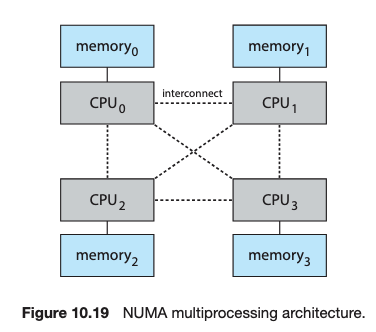
- slower, but can achieve greater levels of throughput and parallelism
- depends on how CPUs and memory are interconnected
Thrasing
- process is thrashing if it is spending more time paging than executing
Causes
- increasing multiprogramming above a certain threshold causes CPU utilization drops and so thrashing
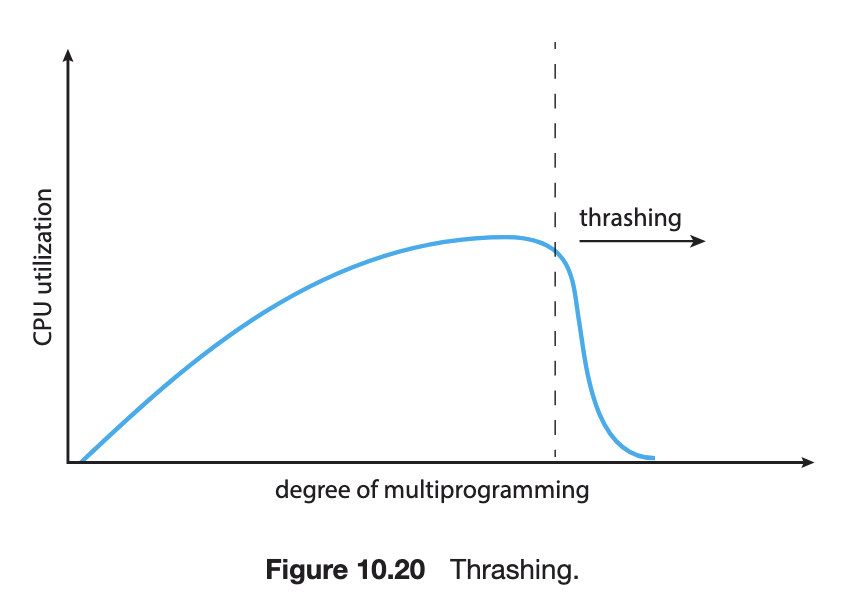
- limit trashing by using a local replacement algorithm
- to prevent, we must provide a process with as many frames as it needs
- example strategy:
- look at how many frames a process is actually using
- locality model = as a process executes, it moves from locality to locality.
- A locality is a set of pages that are actively used together
- example strategy:
Woking-Set model
Model uses a parameter to define the working-set window. The set of pages in the most recent page references is the working set. If a page is in active use, it will be in the working set. If it is no longer being used, it will drop from the working set time units after its last reference.
- approximation of the program’s locality
- accuracy of working set depends on
- if we compute the working-set size for each process we can say where is the total demand for frames
- if ( is the total number of available frames), trashing will occur
- how to use
- OS monitors the working set of each process
- allocates enough frames to provide it with its working-set size
- if there are enough extra frames, initiate another process
- if , select a process to suspend
- process’s pages are swapped and its frames reallocated
- approximate the working-set model with a fixed-interval timer interrupt and a reference bit
- when we get a timer interrupt, we copy and clear the reference bit for each page
- Thus, if a page fault occurs, we can examine the current reference bit and two in-memory bits to determine whether a page was used within the last 10,000 to 15,000 reference
- If it was used, at least one of these bits will be on
Page-Fault Frequency (PFF)
- another, more direct approach
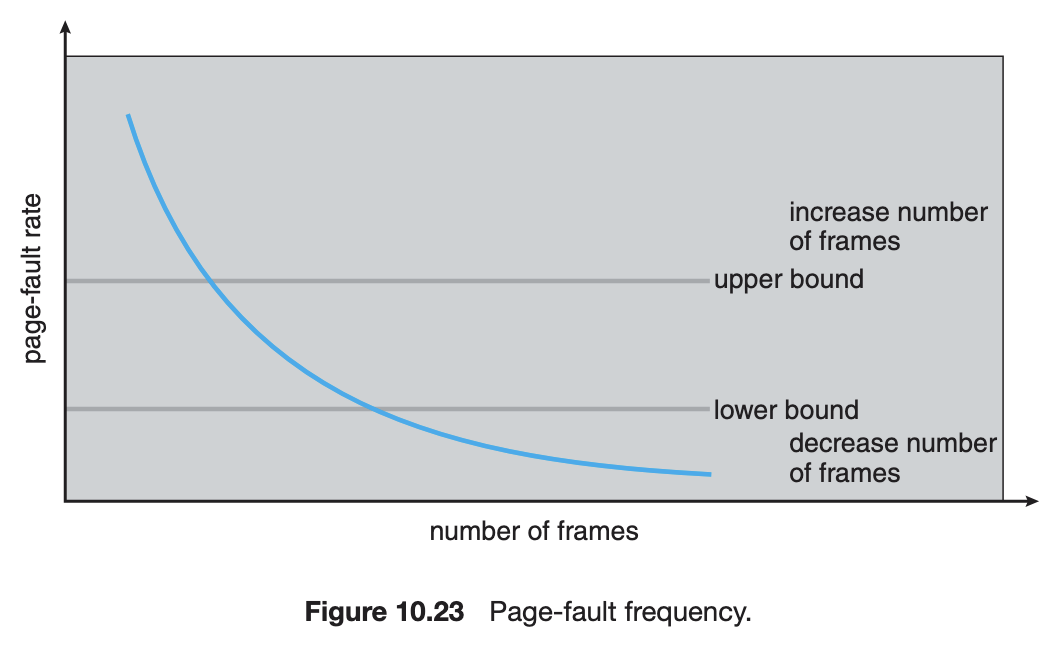
Memory Compression
- alternative to paging
- Compress several frames into a single frame before moving them to the free-frame list. If one of the compressed frames is later referenced, a page fault occurs and the compressed frame is decompressed.
- no paging on mobile systems, but there is memory compression
- higher compression = more expensive algorithms
- WKdm in apple systems
Allocating Kernel Memory
- kernel memory is allocated differently than user mode memory, why?
- minimize internal fragmentation that happens like in user mode
- some hardware devices interact directly with physical memory and they can’t have the benefits of the virtual memory
Buddy system
- allocates memory from a fixed-size segment consisting of physically contiguous pages
- memory is allocated in power of 2 sizes
- divide the segment into two buddies until we can satisfy the request
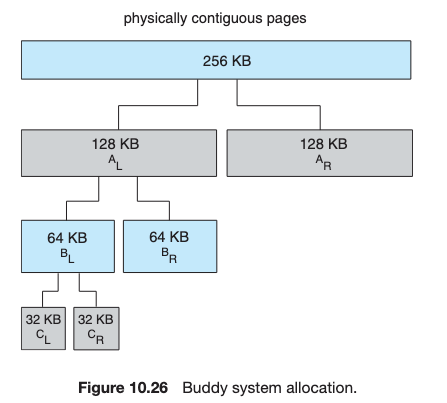
- Pro: fast coalescing (combine buddies to form larger segments)
- Cons: fragmentation due to rounding up to the next highest power of 2
Slab allocation
- slab = one or more physically contiguous pages
- cache = one or more slabs
- one single cache for each unique data structure
- each cache is populated with objects (instantiations of the kernel data structure)
- when a cache is created a number of objects (initially marked as free) are allocated
- when a new object is needed, the allocator assigns any free object from the cache and marks it as used
Pros:
- no memory fragmentation
- memory requests can be satisfied quickly
Linux initially used buddy system, then changed to SLAB and then again to SLUB and SLOB.
SLUB is the default
Questions
Under what circumstances do page fault occur?::first access to a page, page was swapped out of disk, page table entry’s “valid bit” is set to invalid
Describe the actions taken by the operating system when a page fault occurs.::trap the os, check if the memory reference was a legal address, find a free frame, if memory is full OS selects a victim page using a replacement algorithm, load the page from disk, update the page table entry, restart the faulting instruction
Assume that a program has just referenced an address in virtual memory. Describe a scenario in which of the following can occur::-TLB miss with no page fault -TLB miss with page fault -TLB hit with no page fault -TLB hit with page fault