Select Connection: INPUT[inlineListSuggester(optionQuery(#permanent_note), optionQuery(#literature_note), optionQuery(#fleeting_note)):connections]
The main idea of Zettelkasten is to not just read content, but make it stick. This avoids also another problem: the Collector’s Fallacy, the tendency to hoard content to get the feeling of being on the cutting edge.
We don’t change ourselves if we don’t learn, so merely filing things away doesn’t lead us anywhere
The solution is to write while reading while simultaneously having shorter cycles of research, reading and assimilation.
To start, do this exercise:
- Research for one hour. Then process the collected material until the stack is empty
- Do a quick review of the cycle
- Change the research limit if it wasn’t appropriate
But how do I collect material? The stack needs to be curated. My current flow does not involve scientific papers, it is mostly composed of RSS feeds and blog posts.
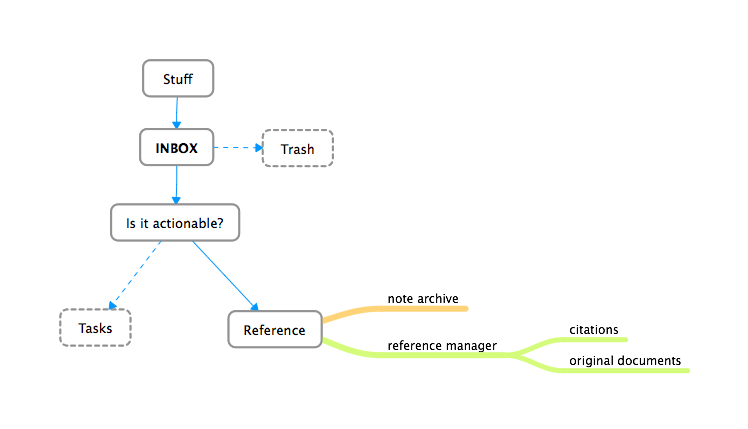 My central place to collect bookmarks and materials to then process will be Raindrop, since it is multi-platform and I can save both from websites and from the RSS reader.
Speaking of RSS reader, I currently use Reeder. Again, multi-platform, I can save directly to Raindrop without any context switching and I can have feeds from different sources such as Youtube. The main downside is that it has a 10 subscription limit, which is not great.
My central place to collect bookmarks and materials to then process will be Raindrop, since it is multi-platform and I can save both from websites and from the RSS reader.
Speaking of RSS reader, I currently use Reeder. Again, multi-platform, I can save directly to Raindrop without any context switching and I can have feeds from different sources such as Youtube. The main downside is that it has a 10 subscription limit, which is not great.
I will try to use the phone RSS reader just for filtering, since I can’t realistically take notes properly on such a small device, even though I am using Obsidian, and paying for the Sync feature.
Daily Flow:
- Filter the RSS feed, save the interesting ones to Raindrop with the tag “todo”. This can be done in the morning while commuting or while waiting for other activities
- When I have time and I am home (after work before or after dinner) go through the daily saves and take notes
- This step will probably add even more things to read. I have to avoid going too deep in rabbit holes if it is not deliberate, mainly to make the habit friction-less (see Atomic habits)
Back Matter
Source
- based_on::
References